Showing posts with label number sense. Show all posts

Saturday, July 2, 2016

Ten-Frame FUN

Helllooooo! Yes, I am still alive. Yes, I am BUSY, BUSY, BUSY. But yes, I am still here! I think about this little old blog often but lately it has had to fall to the bottom of my priority list. :( I'm not back to the same capacity as before when I regularly blogged, but I hope to at least have new resources to share and blog posts once or twice a month. :D

Let's talk ten-frames.


Do you know what a ten-frame is? Do you use ten-frames in your classroom? If you teach math in the primary grades, I hope your answer to both questions is YES, of course! :)

Using ten-frames helps students work specifically on subitizing, composing/decomposing numbers, making 10, relationships between numbers, etc. These simple, yet powerful tools can help lay those building blocks of number sense our students need. Below are some resources you can add to your ten-frame ideas bucket:


  • You can purchase a set of ten-frame cards OR you can pick up a freebie here. Once you have the cards, you are ready to use them with your kids! Use them as flash cards to build their instant recognition of each number.

  • If you are looking for some games to play with your ten-frame cards, I whipped a little math game pack up this week. These games are great for whole group, small group or work station activities! You can check it out by clicking on the picture!


  • Also, here are some great online ten-frame games:
 

  • Finally, this is a fantastic book with lots of great ideas:


Have a GREAT weekend and see you soon! :)

Monday, December 7, 2015

Target Number: A Number Sense Activity

Hey, friends! I hope your week is off to a great start!

Let's talk about number sense:

Do you spend time teaching number sense in your classroom? Number sense isn't just a skill that the primary grades need to practice; older kids need practice too! To practice number sense in my classroom, I've used number of the day, number talks, counting around the circle, number riddles, worksheets, etc. I've done scoots and have used every possible manipulative. No matter what I use, children always seem to enjoy the activity.

Here is one of MANY ways for students to build number sense (add it to the bank):
In this activity, students will have a target number that they must make by following different directions.

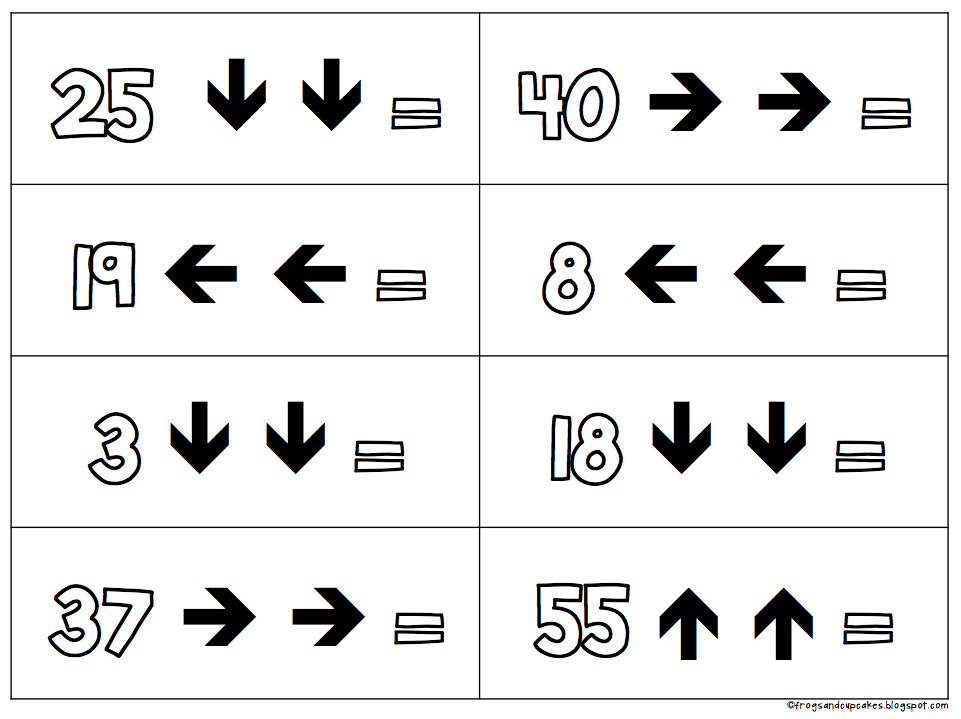
Here is one of the target number pages with directions:


The file comes with three different levels of target number pages and optional recording sheets. Easy peasy and you could implement it in your classroom TOMORROW! Come check it out on TPT!

And here are a few tips for using the Target Number pages...
1) Print the page you are going to use and place it in a report cover. Students can write on it with a dry erase marker and wipe it clean when finished! (like the picture below)
2) Have students use dry erase boards to do the work for the target number.


Need a few other resources to teach number sense? Here are some that I have (including some freebies!):

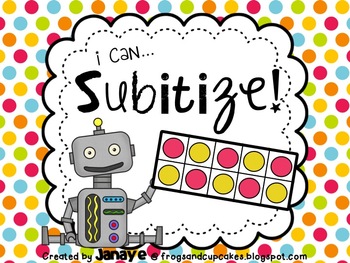
I Can...Subitize!


Sunday, February 1, 2015

Building Number Sense on a 100 Chart

Yes, yes, yes, it has been a while since my last blog post. I'd like to not have so much time in between them but life kind of gets in the way of that!! :)

I am here today to bring you a number sense game that I use as a daily warm-up, but can also be used as a whole group, small group or math center/station activity.

Building number sense is something that all grade levels should must have to, have to can do. ;) It is especially important for K-2 to build number sense in order to lay the foundation for higher level math. (Not to mention that number sense is needed to do everyday activities such as cooking, games and playing sports!)

One tool you can use to help build number sense is the 100 chart:

The activity I want to share is called "Arrow Arithmetic" in It Makes Sense! Using the Hundreds Chart to Build Number Sense (click below to view the book).

In this activity, students will receive a clue such as:
and will use the 100 chart to figure out the answer. So how do they figure out the missing number??? They have to use the arrows and some number sense! 
Each arrow represents a direction you can go on the 100 chart: left (-1), right (+1), down (+10) and up (-10). Students can use a 100 chart to determine that the missing number is 45. Eventually, students will be able to determine the answer using mental math and even be able to solve problems that include diagonal arrows. And what does that eventually lead to?? Being able to add and subtract two-digit numbers using mental math!

Pretty cool, huh?!

I urge you to give this activity a try. My students LOVE it and beg to play it every day (which lately, we have been doing)! And they are REALLY good at it. :)


I made a little activity pack to go with the Arrow Game activity from the book:


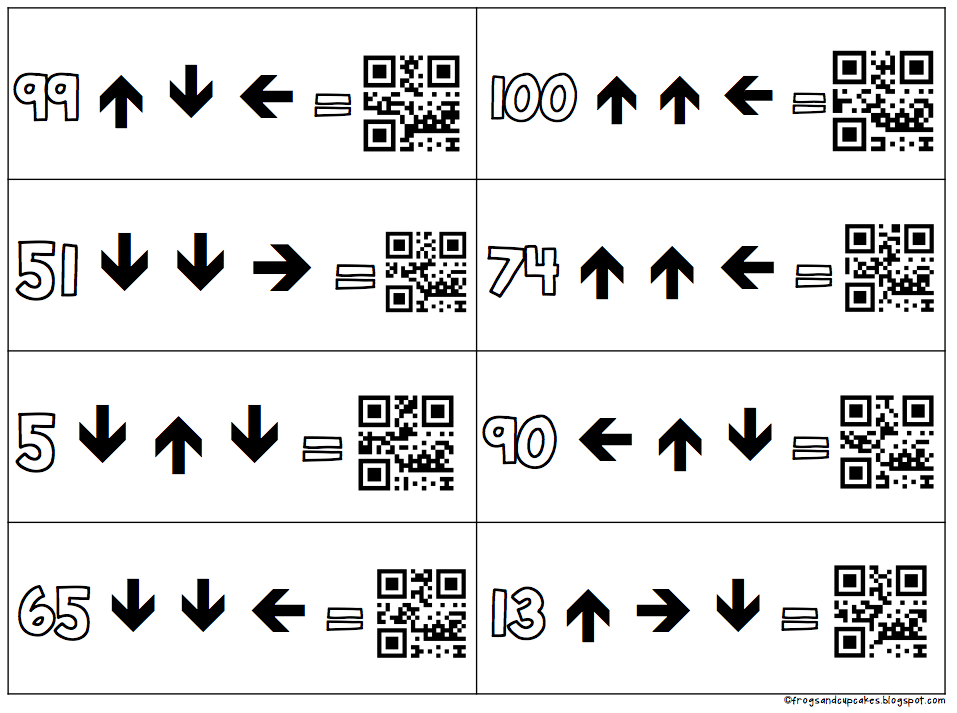
The pack includes two sets of arrow cards, 1 easy and 1 challenging. Also, allow students to self-check with QR codes:


I have also included a few practice pages:


It's even on sale for SuperBowl Sunday!

Check out the activity here:


P.S. Need some 100 charts for your class? I've got a set for your FOR FREE! Click below!

Saturday, September 7, 2013

Part-Part-Whole Chart Action! (and your Sweet & Simple Saturday freebie)

Week 2 is officially over and I am still alive! It has been a fun-packed and BUSY year so far! I ended week 2 with 21 students in my class and they're some pretty sweet kiddos. :)

Yesterday, I introduced the part-part-whole chart to my firsties. They were SO excited to not only get a new chart, but to USE it! (Seriously....they were ecstatic.) They must know its great power. ;)

FIRST, I passed out the chart and we talked about its name and very, very briefly talked about the purpose. We will get more into that later. Then, we rolled a die and put counters in one of the parts. We rolled again and put counters in the other part.

We talked about how many counters were in each part and how we could find out how many counters there were in all. We decided to push the parts together and then count. They discovered that the whole was a great place to put them together and count them up. We did that 2-3 times. Then, I called a student to roll for me and place the counters on my mat under the document camera while the rest of the class did it at the their desk. I called another student for the second roll and placement of counters. We did that FOREVER because they were VERY engaged--they wanted to be picked!! Almost everyone got a turn with that. 


After that, it was time for some independent practice. We played Part-Part-Whole Roll:


They did SUCH a great job. We'll be ready for round 2 of PPW on Monday!!

And here are the possible recording sheets for the game:


Need part-part-whole charts for your classroom?? Here is your Sweet & Simple Saturday freebie:


Have a great weekend!!